As part of the LIFE Cerceta Pardilla project, a technology has been successfully tested to improve habitat management for protected species in wetlands: the use of virtual fencing for livestock. These are virtual fences that create boundaries without physical structures where it is not possible or advisable to install and maintain conventional fences. This tool helps control invasive vegetation while reducing costs and minimising environmental impact.
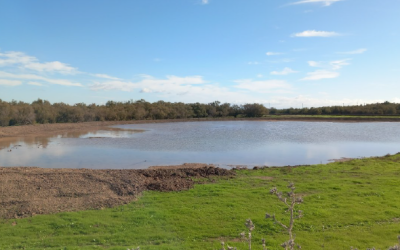
The system was used in the Brazo del Este Natural Area (Seville) thanks to two land stewardship agreements signed with two local farmers, Pedro Manenti and Reyes Manenti. It was implemented over an area of 1.92 hectares almost completely covered by common reed, a plant species whose spread reduces landscape heterogeneity and threatens habitat availability for the marbled teal and other waterbirds. To achieve this, 27 marismeña breed cows were equipped with GPS collars that defined a virtual perimeter using sound signals and electric pulses. Over 17 days, the animals consumed all accessible reed, demonstrating the effectiveness of the system in restoring plant diversity and promoting wetland recovery.

In addition to its effectiveness, this technology offers key advantages for conservation: it enables flexible livestock management, facilitates rotation to prevent overgrazing and directs grazing pressure towards specific areas. It also represents a saving compared to building fixed fences or manual and mechanical clearing, both in terms of material and labour costs and in landscape impact, while avoiding the barrier effect of traditional fences. Furthermore, it provides a viable alternative to the usual difficulty of working in flooded areas.
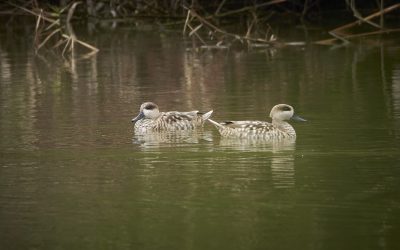
This experience shows that technology can make a decisive contribution to wetland conservation and to improving the habitat of species as threatened as the marbled teal.
LIFE CERCETA PARDILLA
The LIFE Cerceta Pardilla project develops a set of research, conservation, governance and awareness-raising actions to strengthen the status of marbled teal populations in the natural environment, improve the qualityof wetlands and expand scientific knowledge of the species.
Coordinated by the Biodiversity Foundation of the Ministry for Ecological Transition and Demographic Challenge, the partners of the project includepartners: the ministry itself via the Segura River Basin Authority and Tragsatec; the Andalusian Government (through the Regional Ministry of Sustainability and the Environment and the Environment and Water Agency); the Valencia Regional Government (through the Regional Ministry for Environment, Infrastructure and Territory); the Murcia Regional Government (through the Regional Ministry for the Environment, Mar Menor, Universities and Research); as well as the non-governmental organisations SEO/BirdLife and ANSE. The project is supported by the LIFE Program of the European Union and the Directorate-General for Water.