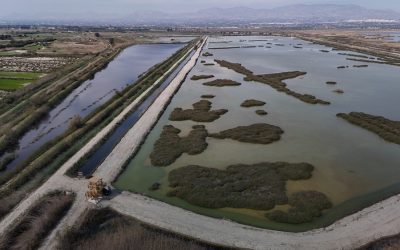
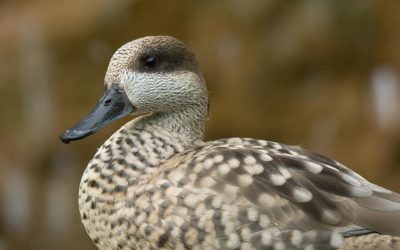
The LIFE Cerceta Pardilla project has completed habitat restoration works at Finca Carnicera, located in the Brazo del Este Natural Area in Seville. This site is protected by the European Union as a Special Protection Area for Birds (SPA). It is also included under the Ramsar Convention, an intergovernmental treaty concerning Wetlands of International Importance. It is one of the most important sites for the breeding of the marbled teal, which is critically endangered in Spain.
The Brazo del Este Natural Area is a former branch of the Guadalquivir River which, following human interventions in the 20th century, became disconnected from the main channel and transformed into an inland marsh. Today it depends exclusively on rainfall, on flooding through pumping in certain sectors by the regional environmental authority of the Andalusian Government, and on return water from nearby rice fields, giving it a unique hydrological character. In dry years, when Doñana does not provide suitable conditions, this wetland becomes a vital refuge for the marbled teal and other threatened waterbirds.
Finca Carnicera contains a short, winding branch of the Guadalquivir River, with several meanders that were silted up and covered with marsh vegetation.
The actions carried out aimed to ensure water management and create optimal areas for bird breeding. To this end, shallow water bodies (known locally as lucios) have been prepared to allow controlled flooding, channels have been cleaned and improved to optimise hydraulic flow, and sluice gates have been installed to regulate water levels in the restored areas. In addition, hydraulic connection with a nearby channel has been secured, and earthworks and vegetation management have been undertaken to restore the ecological functionality of the wetland. In total, 17.4 hectares have been restored.
LIFE CERCETA PARDILLA
The LIFE Cerceta Pardilla project develops a set of research, conservation, governance and awareness-raising actions to strengthen the status of marbled teal populations in the natural environment, improve the status of wetlands and scientific knowledge of the species.
In this project, coordinated by the Biodiversity Foundation of the Ministry for Ecological Transition and Demographic Challenge, the participating partners are the ministry itself via the Segura River Basin Authority and Tragsatec, the Andalusian Government (via the Regional Ministry of Sustainability and the Environment and the Environment and Water Agency), the Valencia Regional Government (via the Regional Ministry for Environment, Infrastructure and Territory), the Murcia Regional Government (via the Regional Ministry for the Environment, Mar Menor, Universities and Research), as well as the non-governmental organisations SEO/BirdLife and ANSE. The project is supported by the LIFE Program of the European Union and the Directorate-General for Water.