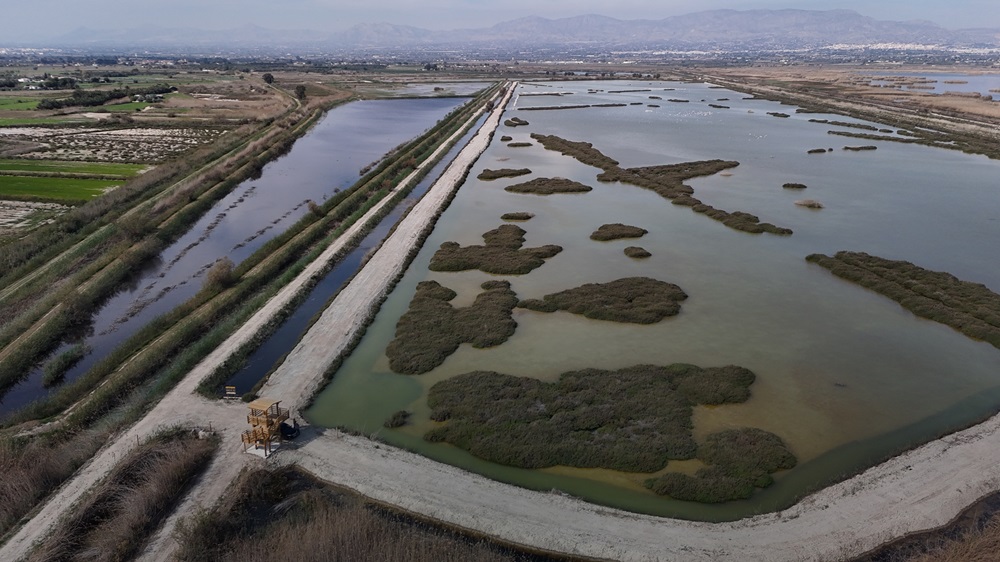
With the restoration of La Raja estate, the actions aimed at improving the ecological conditions of the group of wetlands known as La Raja Lagoons have been completed. These wetlands are located in El Hondo Natural Park, in the province of Alicante, and also include El Espigar estate. Both estates were purchased by the Segura River Basin Authority (Confederación Hidrográfica del Segura) together with the associations ANSE and SEO/BirdLife as part of the LIFE Cerceta Pardilla project, to be restored and used for the conservation of the species and the biodiversity associated with its habitat, thewetlands.
These estates are identified in the Strategy for the Conservation of the Marbled Teal, Redknobbed Coot, Whiteheaded Duck and Ferruginous Duck in Spain as priority areas for species conservation, as they have hosted up to 30% of the Spanish breeding population in some years. However, the annual breeding success of the marbled teal on these plots depended on water management, since, in order to allow waterfowl hunting—the main economic activity on both estates—the lagoons were only flooded during the winter period, remaining dry the rest of the year, which seriously threatened the survival of the species.
At the time of purchase in June 2021, El Espigar estate showed an advanced state of neglect and suffered from silting and diffuse pollution problems. La Raja, acquired by the Segura River Basin Authority in 2024, was in a better state of conservation, although it showed clear signs of deterioration linked to a lack of maintenance of the hydraulic system, as well as excessive reed growth in some areas.
IMPROVEMENTS TO THE ESTATES
The actions carried out covered hydrology, threat reduction, habitat improvement and public use of the estates.
Regarding the first point, the hydraulic system has been improved and upgraded. A total of 21 sluice gates were repaired or installed, hydraulic connections between the estates were established, and the pumping station at La Raja was refurbished. These measures now make it possible to control water circulation between the estates, allowing independent flooding of plots and estates and enabling water levels to be maintained for longer periods. Across the lagoon system, the water surface area has increased by between 40% and 60%.
In terms of habitat restoration, marsh vegetation was cleared from the edges and interior of the lagoons, as well as from channels and irrigation ditches supplying water. This made it possible to recover 7.7 hectares of open water at El Espigar. A salt marsh and an irrigation pond were also restored, and embankments were revegetated with native species, enabling the flooding of 7 new hectares. At La Raja, islands were created and the surface area of the beaches was increased.
For management and public use, three jetties were built, two at La Raja and one at El Espigar, and a boat was acquired for lagoon management. Three observation towers and a wildlife observatory were also installed, along with interpretive and directional signage, as well as two multiparameter monitoring stations and two video surveillance cameras at La Raja for environmental monitoring. At El Espigar, 3,600 metres of paths were restored, while existing paths at La Raja were cleared.
Regarding threat reduction, the purchase of the estates led to the immediate cessation of hunting on both estates. In addition, the presence of invasive species was reduced by removing 300 linear metres of invasive cane and planting native species such as giant reed (caña judía), tamarisk, Scirpus and Juncus.
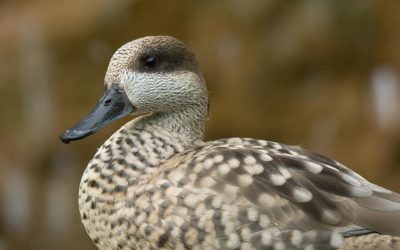
Finally, since 2022, 150 marbled teals have been released on the estates, with 5 broods recorded in 2023, 4 in 2024 and 7 in 2025, demonstrating an improvement in habitat conditions for the species’ reproduction.
JOINT MANAGEMENT AND LONG-TERM CONSERVATION
Since their acquisition, the estates have been jointly managed by the owner organisations. Once the project has been completed, La Raja Lagoons will continue to be managed as a single management unit under an agreement signed by the parties involved. All the actions carried out will ensure the availability of suitable habitat for the marbled teal and other waterbird species throughout the year.
THE LIFE CERCETA PARDILLA PROJECT
The LIFE Cerceta Pardilla project develops a set of research, conservation, governance and awareness-raising actions to strengthen the status of marbled teal populations in the wild, improve the status of wetlands and scientific knowledge of the species.
In this project, coordinated by the Biodiversity Foundation of the Ministry for Ecological Transition and Demographic Challenge, the participating partners are the ministry itself via the Segura River Basin Authority and Tragsatec, the Andalusian Government (via the Regional Ministry of Sustainability and the Environment and the Environment and Water Agency), the Valencia Regional Government (via the Regional Ministry for Environment, Infrastructure and Territory), the Murcia Regional Government (via the Regional Ministry for the Environment, Mar Menor, Universities and Research), as well as the non-governmental organisations SEO/BirdLife and ANSE. The project is supported by the LIFE Program of the European Union and the Directorate-General for Water.